Why NYC Professionals Want Structure, Not Motivation?
The Short Answer
Structure turns insight into repeatable execution.
Motivation can initiate action, but it fluctuates. Professionals operating under sustained pressure need a structure that clarifies priorities, converts decisions into specific actions, establishes accountability, and measures whether those actions are producing meaningful progress.
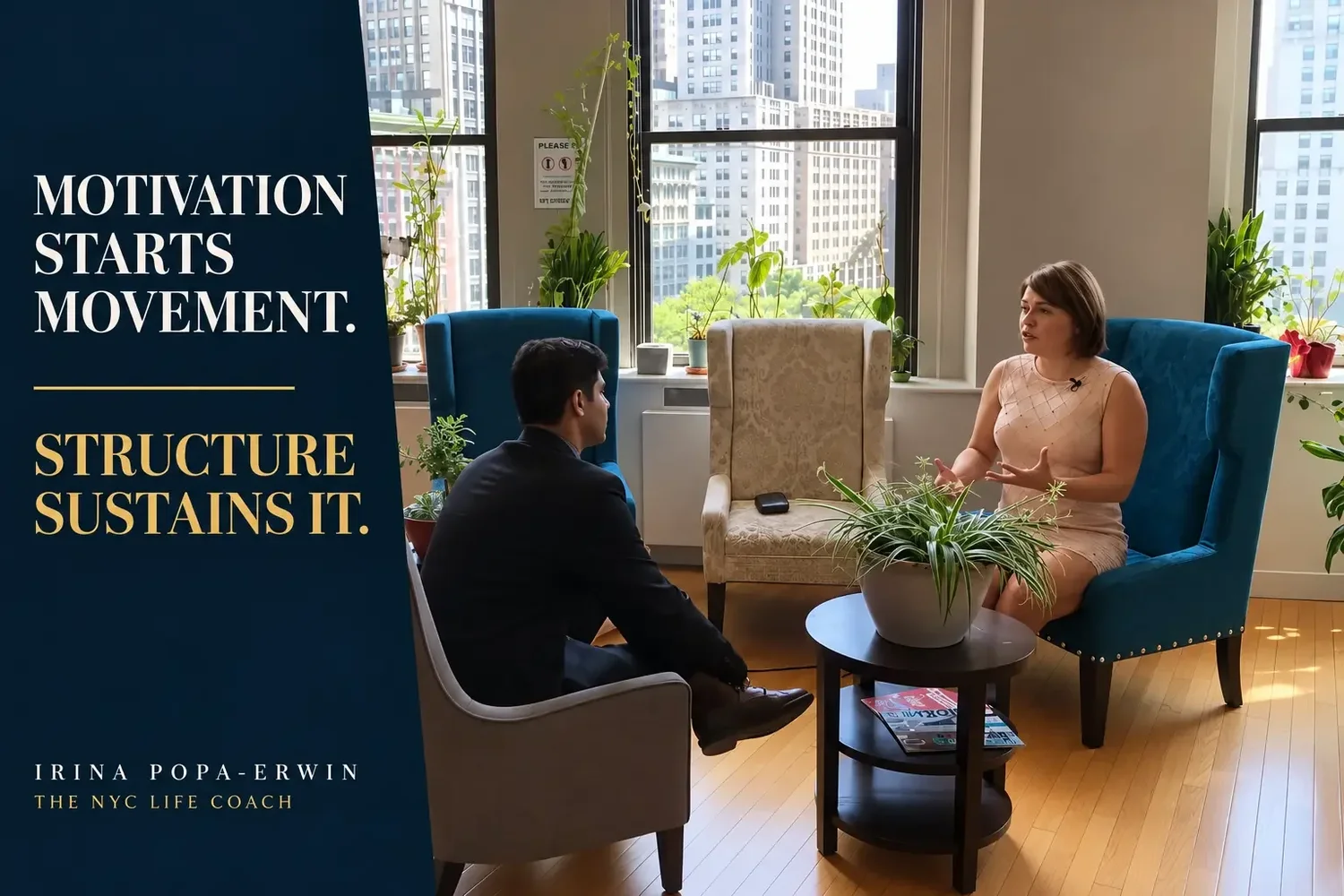
01 — Motivation Versus Structure
Motivation creates energy; structure determines where it goes.
Ambition is rarely the central problem for accomplished professionals. Many already possess discipline, knowledge, and a strong capacity for sustained effort. The difficulty is directing that capacity toward the right priorities while operating under pressure.
In New York City, leaders and professionals often make decisions within compressed timelines, competing priorities, demanding organizations, and environments where one reactive decision can affect a team, reputation, career, or business outcome.
Motivation may create a temporary surge of energy, but it does not automatically establish priorities, expose blind spots, resolve conflicting objectives, or create a reliable execution process.
Motivation alone
- Depends heavily on mood and immediate emotion
- Creates energy without necessarily creating direction
- Can disappear when demands or resistance increase
- Often produces short periods of activity
- May leave the underlying pattern unchanged
Structure
- Clarifies which outcome matters most
- Connects daily behavior to a larger objective
- Creates standards that remain when energy changes
- Defines actions, deadlines, and accountability
- Makes progress easier to evaluate and adjust
02 — The Coaching Architecture
What should a structured coaching process include?
Structured coaching is not a rigid formula. It is a disciplined architecture personalized to the client’s objectives, responsibilities, patterns, environment, and pace.
01
A defined outcome
The engagement begins by clarifying what must change and what a meaningful result would look like.
02
An honest assessment
Current decisions, habits, priorities, assumptions, and recurring obstacles are examined without avoiding uncomfortable evidence.
03
A strategic sequence
Large objectives are translated into decisions and actions arranged in a logical and achievable order.
04
Consistent accountability
Commitments are reviewed, inconsistencies are addressed, and avoidance is distinguished from a legitimate course correction.
05
Progress measurement
Behavioral, professional, and measurable indicators are used to determine whether the strategy is producing movement.
06
Strategic adjustment
The approach evolves when new information, responsibilities, or obstacles change the circumstances.
03 — The Missing Link
Accountability is not additional pressure—it is an operating standard.
Many professionals already know what they should be doing. The persistent gap is between knowing and executing consistently when time, energy, confidence, or circumstances change.
Meaningful accountability does not consist of reminders or criticism. It creates an honest record of what was decided, what was completed, what was avoided, and what must happen next.
Decision standards
Important choices are evaluated against long-term priorities instead of temporary emotion or convenience.
Time standards
Calendars and daily actions reveal whether stated priorities are receiving meaningful attention.
Performance standards
Progress is assessed by behavior and outcomes—not by intention, explanation, or temporary enthusiasm.
04 — The 90-Day Progression
From clarity to execution to sustainable performance.
A structured 90-day coaching engagement creates enough continuity to identify patterns, implement meaningful actions, evaluate resistance, and reinforce stronger behavior.
Phase 01 — Clarity
Define reality and direction
Clarify objectives, competing priorities, recurring patterns, responsibilities, values, and the measurable or behavioral outcomes the engagement is designed to produce.
Phase 02 — Execution
Turn decisions into action
Establish the strategic sequence, implement specific actions, address hesitation and avoidance, and evaluate what happens when the plan meets real pressure.
Phase 03 — Integration
Make performance repeatable
Strengthen the decisions and behaviors that produce progress, correct remaining inconsistencies, and create standards that continue beyond the engagement.
05 — Different Objectives, One Standard
Structure matters across life, career, and leadership decisions.
The objective may change, but the need for clarity, strategic action, accountability, and evaluation remains.
Executive leadership
Clarify decision authority, communication standards, leadership presence, team expectations, and performance under scrutiny.
Career advancement
Define the target position, close capability or positioning gaps, strengthen professional visibility, and execute a deliberate transition.
Business performance
Separate strategic priorities from operational noise, improve judgment, and establish consistent execution around the highest-value actions.
Personal performance
Identify the habits and beliefs influencing decisions, establish meaningful standards, and align behavior with stated priorities.
Stress and burnout
Examine workload, boundaries, decision patterns, recovery, and the structural conditions required for sustainable performance.
06 — Evaluate the Process
Signs a coaching engagement may lack sufficient structure.
- Every session begins without a defined connection to the larger objective
- The conversation produces insight but no specific action
- Previous commitments are rarely reviewed
- Progress is described only through feelings or temporary motivation
- The same formula is applied regardless of the client’s circumstances
- The coach avoids challenging inconsistencies or repeated excuses
- There is no clear distinction between adjustment and avoidance
- The engagement has no defined outcome, progression, or evaluation method
07 — Experience Behind the Method
Structure must be informed by real-world judgment.
A framework is only as valuable as the judgment behind it. An experienced coach must know when to challenge, when to listen, when to adjust the strategy, and when a client is negotiating with the standard they previously established.
Irina Popa-Erwin’s coaching methodology brings together the discipline developed as a former professional athlete and nine-time Gold Medalist, Jim Rohn’s mentorship principles, and more than 20 years of business leadership and professional coaching experience in New York City.
The objective is not to impose a generic system. It is to create the personalized structure required for an individual to think clearly, act decisively, and perform consistently under pressure.
Learn more about Irina Popa-Erwin’s experience →Information explains what to do. Structure determines whether it becomes consistent behavior.
08 — Measuring Progress
What should structured coaching produce?
Results will differ by person and circumstance, and no ethical coach can guarantee a specific outcome. However, a disciplined engagement should create observable movement in how the client thinks, decides, communicates, and executes.
- Clearer priorities and fewer competing objectives
- More deliberate decisions under pressure
- Specific actions connected to meaningful outcomes
- Greater consistency between stated priorities and actual behavior
- Earlier recognition of avoidance and recurring patterns
- Stronger accountability and follow-through
- A more accurate understanding of progress and remaining obstacles
- Standards that remain useful when motivation changes
The Bottom Line
Professionals do not need more information without implementation.
They need clarity about what matters, a strategy that converts intention into action, accountability that exposes inconsistency, and standards capable of surviving pressure.
Motivation still has value. It can initiate movement and reconnect a person with possibility. But sustainable progress requires something stronger: a structure that continues directing behavior after the emotional intensity of the moment has passed.
A Private Conversation
Where is the gap between what you know and what you consistently execute?
Private coaching with Irina Popa-Erwin creates the clarity, strategy, accountability, and personalized structure required to turn intention into repeatable personal and professional performance.